



Get this deal! Call now.
Speak with a vehicle protection plan specialist and get $300 off any new contract instantly.
Call 866-678-4172
or scan the code below

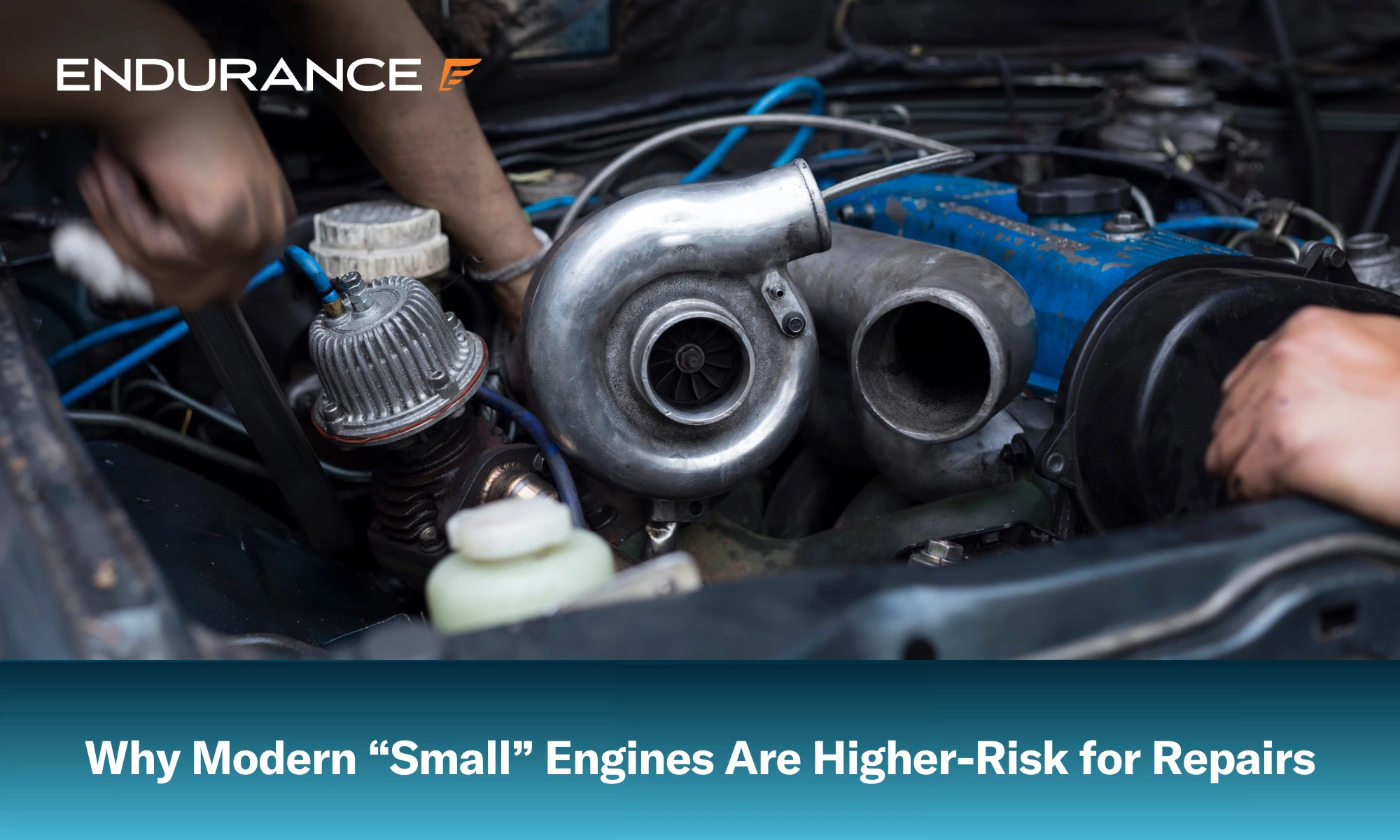
Smaller, more powerful engines have become the norm for many automakers looking to improve fuel efficiency (and thus mpg), reduce vehicle weight, and lower emissions. To make this happen, manufacturers are increasingly relying on turbocharged and gasoline direct-injection (GDI) powerplants.
However, these engines run hotter, operate under higher pressure, and use more components in tighter spaces than naturally aspirated engines. As a result, engine repairs for these vehicles can be costly once the factory warranty expires, and assuming a smaller engine automatically means lower ownership expenses can be a mistake.
Whether you already own a vehicle with a turbocharger or GDI system or are considering buying one, here’s what you should know about the real-world repair risks and costs behind these engines.
Smaller engines are nothing new; they’ve been around for decades. What’s different now is how they’re engineered to maximize performance and efficiency.
Turbocharging uses exhaust gases to increase power output. What was once a technology reserved for performance-oriented vehicles is now common even in everyday cars like the Honda Accord and Ford Escape. A turbocharger operates at high temperatures (connected to the engine and in a cramped engine bay), often spinning at extremely high rpm. Non-stop heat cycles can degrade bearings and seals, while critical oil passages become restricted. Replacing a turbocharger is expensive (repair costs are highlighted below), not only due to the components but also to the labor required to remove and install the interconnected parts. In the automotive world, complexity often leads to higher repair bills.
Fuel injection replaced carburetors in the 1980s to improve reliability. Today, the focus is on efficiency, so automakers have adapted to GDI systems, which spray fuel directly into the combustion chamber under high pressure (traditional port injectors spray fuel into the intake). This newer process places the fuel pump and injectors under greater stress, creating additional weak points that are more common than in port-injected engines.
A benefit of port injection is that fuel sprays over the intake valves, which creates a cleaning effect. On the other hand, GDI lacks this advantage because fuel is injected directly into the cylinder. Over time, carbon and other deposits accumulate on the intake valves in GDI engines, requiring professional cleaning to maintain peak performance.
A smaller turbocharged engine may be well-suited to a compact sedan, but the same powertrain may be less ideal in a heavier SUV. Family-friendly crossovers like the Toyota Highlander and Ford Explorer once came standard with straightforward V6 engines. Newer versions now use turbocharged four-cylinder engines as base equipment. Add the weight of a larger body, additional passengers, extra cargo, and stop-and-go traffic, and that turbo engine is pushed into sustained boost and frequent heat cycles. That doesn’t guarantee turbo engine reliability issues will appear later, but the added stress increases vulnerability to costly repairs.
Real-world data show that owning a car with a turbocharged or GDI engine carries significant financial risks without warranty protection. Here’s a cost breakdown for common issues.
A turbocharger can fail due to bearing wear, oil starvation, seal degradation, or simply age and heat cycling. The average replacement cost ranges from $2,364 to $2,962, which includes $695 to $1,020 in labor. It’s not unusual for adjacent components to require attention. For example, swapping out intercooling plumbing can run another $580 to $643. Are turbo engines expensive to repair? Yes.
Fuel injector problems often appear as engine misfires, rough idling, hard starting, and poor fuel economy. It’s an issue that requires prompt attention to avoid damage to the catalytic converter, pistons, and other components. The typical cost of new injectors is $763 to $966. On some engines, the actual repair bill can be higher if there’s an underlying cause of injector malfunction.
Fuel pumps in GDI systems add complexity due to the demands of high-pressure fuel delivery. The average cost to replace a fuel pump is $1,226 to $1,479, but don’t be surprised if the bill is higher due to additional diagnostic and labor requirements.
Hesitation, rough idling, or engine misfires can indicate carbon buildup on the intake valves in GDI engines. This usually isn’t a problem with newer cars, but it arises after 50,000 to 60,000 miles of driving. Correcting this problem (buildup removal) straddles the line between maintenance and repair, but can still come with a hefty price tag. A basic professional cleaning typically starts at around $200, but the total can reach $500 at a dealership service department. More elaborate methods, such as spraying crushed walnut shells (similar to sandblasting), can be even more costly.
The idea of higher heat, higher pressure, and greater complexity contributing to more expensive engine repairs is more than theory. A 2018 Consumer Reports article, “Troubles with Turbo Engine Reliability,” highlights this reality. Research from the organization shows that some brands (Buick, Chevrolet, Ford, Hyundai, Kia, Lincoln, Mini, Volkswagen, Volvo, and even BMW) are especially trouble-prone with their turbocharged powerplants.
Even brands with a strong reputation for reliability aren’t immune. For instance, CarComplaints maintains a running account of engine and fuel system problems associated with the 2018 Honda Accord, which the website dubs “Really Awful.” This was the first year of the all-new tenth generation, which replaced larger-displacement engines with smaller, turbocharged powerplants. The log of over 200 owner reports includes high-mileage examples.
Driving habits can also increase the risk of engine problems:
One unpleasant part of car ownership is that repair bills often arrive at the least opportune time. Not only is your schedule disrupted, but your bank account or credit card also takes the hit. A $2,700 turbo replacement isn’t welcome by anyone.
However, there is a way to make the cost of surprise repair bills more manageable: an extended warranty (also called an auto protection plan or vehicle service contract). This aftermarket coverage replaces paying out of pocket for repairs with a one-time or smaller monthly payment. It’s one of the best ways to avoid the shock of repair bills that can be connected to turbocharged or GDI-equipped engines.
For example, Endurance Warranty offers essential powertrain protection (covering the engine, transmission, and drive axles). As mentioned, a turbocharger replacement costs about $2,700. You could pay for the repair in a single payment to the shop. Or pay that amount through smaller, more manageable monthly payments over two years and be protected against turbocharger failure and other covered repairs (coverage must be secured before mechanical issues arise).
An extended warranty isn’t for every car owner. It’s not something you’ll need if you trade vehicles every few years and stay within factory coverage limits. However, an extended car warranty makes sense in several scenarios:
Keeping a car past its original warranty simply creates more opportunities for a major mechanical failure. Eventually, every vehicle needs service, but turbochargers and high-pressure fuel systems can increase the likelihood of a visit to the shop. Some drivers gain greater peace of mind by adding an auto protection plan immediately after the factory bumper-to-bumper or powertrain warranty ends. Still, others are willing to assume more risk and wait for the odometer to near six figures.
Buying a used vehicle can be a smart financial move, but you’re also taking ownership when there’s an increased risk of expensive repairs. Adding a turbocharged or GDI engine to the equation can bring uncertainty if you don’t know how strict the previous owner was about oil quality, warm-up practices, or maintenance intervals.
Daily use introduces additional cycles and other stresses as you sit in traffic or rack up the miles. These driving patterns accelerate the timeline for age-related repairs.
Turbocharged or GDI-equipped cars are everywhere. Here are a few examples that could benefit from extended warranty protection:
The factory warranty is designed to cover defects that arise early in a car’s life, not mechanical failures that occur years (and tens of thousands of miles) down the road. After this limited protection ends, responsibility for repairs shifts to the owner. For drivers unwilling to assume this risk, an extended warranty can provide safeguards for critical systems, including today’s small engines. It enables owners to budget for repairs with confidence, preserving drivability and resale value.
Endurance plans offer:
While turbocharged or GDI engines may be unavoidable with your vehicle choice, paying for repairs isn’t. Endurance offers a range of vehicle protection plans that make car ownership costs more predictable and breakdowns less stressful.
Discover how to best protect your car by requesting a FREE quote or visiting the Endurance online store for instant plan and pricing information. Endurance representatives are also available at (800) 253-8203.
Read the Endurance blog for expert-written articles covering DIY tips, repair advice, warranty insights, vehicle reviews, and more.

We've received your vehicle information and will contact you shortly with your quote.
— OR —
Start shopping for a coverage plan now.


We're here to make sure you get the most comprehensive EV protection. That's why we've partnered with Xcelerate Auto to offer you transparent and dependable Tesla coverage.
Want us to contact you about XCare coverage for your Tesla?

Your protection is our top priority. Your quote is in progress and you will
receive a confirmation
email shortly.

Speak with a vehicle protection plan specialist and get $300 off any new contract instantly.
$300 off + FREE Elite Benefits for 1 year!
By clicking the button, you consent to Endurance using automated technology to call, email, and text you using the contact info above, including your wireless number, if provided, regarding auto protection or, in California, mechanical breakdown insurance. You also agree to the Endurance Privacy Policy and Terms and Conditions. Consent is not a condition of purchase, and you can withdraw consent at any time. Message and data rates may apply.
Speak with a vehicle protection plan specialist and get $300 off any new contract instantly.
Call 866-678-4172
or scan the code below

Simply fill out the information below and we will follow up fast with your free no-obligation quote.
By clicking the button, you consent to Endurance using automated technology to call, email, and text you using the contact info above, including your wireless number, if provided, regarding auto protection or, in California, mechanical breakdown insurance. You also agree to the Endurance Privacy Policy and Terms and Conditions. Consent is not a condition of purchase, and you can withdraw consent at any time. Message and data rates may apply.

To speak to a vehicle protection plan specialist and get $300 off any new contract instantly
Scan the code below



Since the age of 16, Keith has been immersed in the automotive industry, beginning his career by helping his dad fix vehicles at a young age. Keith now owns his own family-run, ASE Certified repair shop, A+ Autocare. At his shop, he focuses on building trusting relationships with his community through exceptional customer service. Read more about Keith.