

Get this deal! Call now.
Speak with a vehicle protection plan specialist and get $300 off any new contract instantly.
Call 866-678-4172
or scan the code below
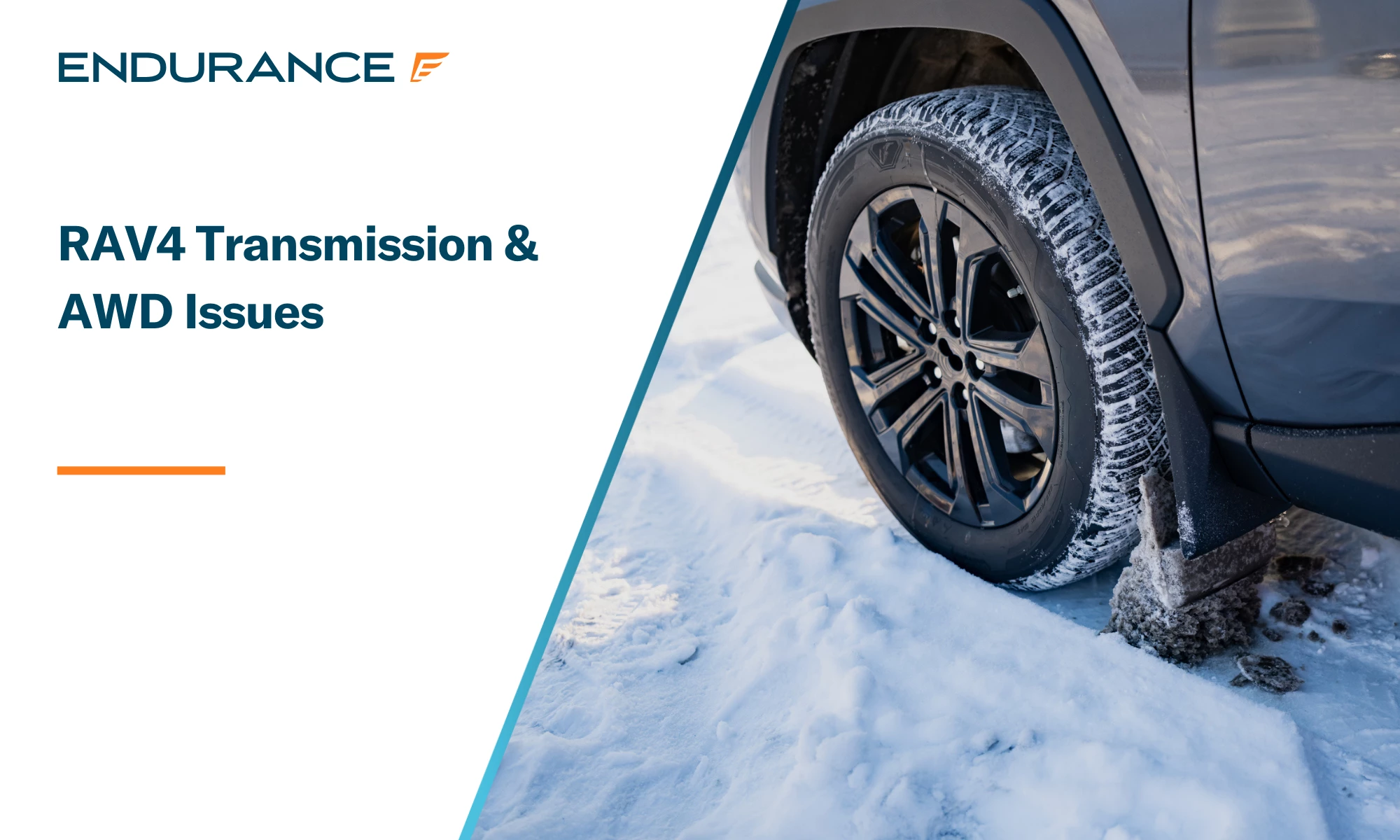
While the Toyota RAV4 enjoys a solid reputation for dependability, it’s not perfect; no vehicle is. One potential trouble spot is the transmission, which is significant because of the potential for high repair costs. Internal claims data from Endurance reveals that the average transmission replacement costs almost $4,700, an eye-opening number. These Toyota RAV4 issues range from harsh shifting to gear change lags and fluid leaks. Faulty electronics, such as a defective sensor or a bad control module, could also be at the heart of Toyota RAV4 problems with the transmission. Adding all-wheel drive (AWD) to the equation adds more complexity and expense.
Of course, not every RAV4 will encounter a transmission issue, but consumer complaint databases report it’s the worst problem for Toyota’s best-selling model. Some years are more vulnerable than others. Surprisingly, the 2019 model year is well-known for hesitation and lurching at lower speeds despite its newer status. Yet, the troubles are even worse for the 2001-2003 RAV4, which has a well-documented history of shifting issues and transmission failure. These older examples earn strong negative ratings.
Whether you already own a RAV4 or are thinking of putting one in the driveway, understanding what’s involved with this Toyota’s transmission is critical. We’ll cover basic transmission function, common symptoms, repairs, maintenance, and protection against repair costs.
The transmission in a RAV4 functions like any other: converting engine power into torque transmitted to the drive wheels at an appropriate gear for the driving conditions. The non-hybrid RAV4 has a conventional automatic transmission, while the Toyota RAV4 Hybrid has a continuously variable transmission (CVT). Some older RAV4s were available with a manual transmission.
If AWD is involved, the system uses sensors to monitor wheel speed and automatically powers the rear wheels if reduced traction is detected. Unlike other Toyotas, like the 4Runner or Sequoia, with a traditional 4×4 setup, the Toyota RAV4 AWD system activates automatically if the computer senses wheel slippage. Otherwise, only the front wheels are propelling the car.
As a result, the RAV4’s engine and transmission share an electronic control unit (the ECU is a type of computer), speed sensors, and other vital components. That integration matters because if a check engine light appears, an AWD system malfunction may cause it to deactivate as a precaution. So, an issue seemingly unrelated to the transmission can cause AWD trouble in a RAV4.
When RAV4 transmission problems develop, they seldom start with complete gearbox failure—you’re more likely to encounter warning signs first. The trick is to be aware of these red flags to address problems immediately, which may help limit additional repair costs.
RAV4 transmission problems often start with abrupt gear changes. Gear upshifting or downshifting that was once almost imperceptible is now very noticeable. It’s a common transmission issue in the 2001-2003 RAV4 with the 2.0-liter engine. An owner of a 2002 RAV4 reported to a consumer complaint database that “when the transmission goes from first to second gear, it really jerks and jumps.” Another added, “my transmission started going from first to third gear and clunking when put in reverse.” This stumbling or lurching can happen at lower speeds, but is just as likely during highway acceleration.
Harsh shifting RAV4 symptoms aren’t likely to go away on their own and may get worse. However, remember that the problem may not be the transmission itself but supporting systems such as the ECU, throttle position sensor, or shift solenoid. Gear slippage is another reason to get your RAV4 looked at right away. You may notice the engine RPMs rise without a matching acceleration boost.
Another RAV4 AWD malfunction alert is more obvious: a drivetrain warning in the driver information display. The alert could be accompanied by a “2WD Mode Engaged” message, indicating the car is operating in front-wheel drive only to prevent possible damage to the AWD system. Other telltale signs of transmission issues include a whining or grinding noise during gear changes. Also, pay attention to any transmission fluid leaks, which may appear as reddish drops or puddles under the car.
Although complex transmission and AWD issues are best left in professional hands, many owners can perform basic diagnostics. These require a systematic approach combining visual inspection, code scanning, and real-world confirmation.
Start by confirming the transmission fluid change interval detailed in the owner’s manual or maintenance guide. Toyota generally recommends changing transmission fluid every 30,000 to 60,000 miles, which can vary depending on the drivetrain and your driving habits. Inspect the fluid level and condition (check the owner’s manual for instructions). Toyota transmission fluid in good condition should have a reddish-pink color. Fluid that’s dark brown may be contaminated or past its prime.
As mentioned, the AWD light on RAV4 issues may not be connected to a transmission problem. Sometimes, all it takes is a loose gas cap to trigger an evaporative emissions control (EVAP) system error. An inexpensive OBD-II code reader can help identify this issue; look for diagnostic trouble code (DTC) P0457. Inspect the gas cap, and retighten or replace it as needed. You may have to drive 50-100 miles for the system to reset. However, pay attention to other transmission trouble symptoms and warning lights.
Transmission-specific fault codes include P0750, P0753, P0755, P0758, and P1760, which relate to different solenoids (valves) that control the gearbox. A mechanic will need to diagnose these codes further to pinpoint mechanical failure or an electrical fault, but at least you’ll be better informed before repairs.
A road test is another vital part of the diagnostic process, but it should be handled by a mechanic trained to work on transmissions. There’s more to it than getting behind the wheel for a few minutes. The technician observes shift patterns during the road test and listens for unusual noises. A professional-grade code scanner will monitor live data streams, transmission temperature, system pressure, and solenoid function. AWD operation will also be checked to ensure power is distributed correctly to the rear wheels, especially during cornering and acceleration.
Replacing a transmission is one of the costliest repairs a RAV4 owner can face, but many other drivetrain-related services can impact your wallet. Knowing this information will better prepare you if faced with a transmission issue. You’ll also be able to decide if an extended warranty makes financial sense. We reviewed RepairPal-estimated prices for common transmission-related repairs and services.
In the worst-case scenario, a replacement transmission for a RAV4 costs between $5,787 and $6,297. While this isn’t the solution for every gearbox issue, transmission failures aren’t unheard of. Non-hybrid RAV4s with AWD have transfer cases; installing a new one costs $3,159 to $3,471. Meanwhile, an older RAV4 with a rough-shifting transmission may need a new ECU for $1,194 to $1,240.
It’s not unusual to encounter a faulty shift cable, which costs $510 to $617 to replace. A wheel speed sensor is essential for the AWD system to function correctly. Expect to pay $335 to $528 for a new one. The price for a new solenoid can vary by type of RAV4 model year, but a brake shift interlock replacement runs $245 to $305. Keeping a RAV4 well-maintained can also reduce the risk of transmission trouble. A transmission fluid change costs $230 to $310.
There’s no escaping that some RAV4s are vulnerable to transmission and AWD system issues. However, paying attention to your driving habits and staying on top of maintenance can lessen the odds of trouble.
Jackrabbit acceleration can stress transmission components. So, avoid stomping the accelerator in favor of a gentler approach. You’ll also want to let the engine warm up before driving off. Extended waiting isn’t required; just don’t start the car and immediately shift into gear. Also, take a moment to come to a complete stop before shifting between drive and reverse. Lastly, be aware of your RAV4’s towing and payload limits (check the owner’s manual).
Here’s a checklist to keep your RAV4’s transmission in peak condition:
Facing RAV4 transmission troubles alone can be worrisome, especially when some repairs cost thousands. The factory powertrain warranty only lasts five years or 60,000 miles, so many owners opt for a Toyota extended warranty or a vehicle service contract available through Endurance. This vehicle service contract, also called an auto protection plan or extended car warranty, can help reduce out-of-pocket costs for covered breakdowns.
Endurance offers a range of plans starting with powertrain protection that covers the engine, transmission, and drive axles. There are options for safeguarding the electrical system, steering, suspension, air conditioning, brakes, and other systems. Endurance’s Supreme plan provides exclusionary-style coverage for many vehicle components.
Every Endurance plan includes 24/7 roadside assistance with towing support, rental car benefits, trip interruption protection, and the freedom to select any licensed facility for covered repairs, including dealership service departments. Plan holders are also eligible for a year of Elite Benefits. Get access to tire repairs and replacements, key fob replacement, collision repair discounts, and windshield coverage.*
You can drive your RAV4 with confidence even after the original warranty has expired. Discover your options by requesting a FREE quote or visiting the Endurance online store for instant plan and pricing information. Personalized help is available by calling an Endurance representative at (800) 253-8203.
Stay on top of car maintenance, repairs, and other automotive advice by reading the Endurance blog.

We've received your vehicle information and will contact you shortly with your quote.
— OR —
Start shopping for a coverage plan now.


We're here to make sure you get the most comprehensive EV protection. That's why we've partnered with Xcelerate Auto to offer you transparent and dependable Tesla coverage.
Want us to contact you about XCare coverage for your Tesla?

Your protection is our top priority. Your quote is in progress and you will
receive a confirmation
email shortly.

Speak with a vehicle protection plan specialist and get $300 off any new contract instantly.
$300 off + FREE Elite Benefits for 1 year!
By clicking the button, you consent to Endurance using automated technology to call, email, and text you using the contact info above, including your wireless number, if provided, regarding auto protection or, in California, mechanical breakdown insurance. You also agree to the Endurance Privacy Policy and Terms and Conditions. Consent is not a condition of purchase, and you can withdraw consent at any time. Message and data rates may apply.
Speak with a vehicle protection plan specialist and get $300 off any new contract instantly.
Call 866-678-4172
or scan the code below
Simply fill out the information below and we will follow up fast with your free no-obligation quote.
By clicking the button, you consent to Endurance using automated technology to call, email, and text you using the contact info above, including your wireless number, if provided, regarding auto protection or, in California, mechanical breakdown insurance. You also agree to the Endurance Privacy Policy and Terms and Conditions. Consent is not a condition of purchase, and you can withdraw consent at any time. Message and data rates may apply.

To speak to a vehicle protection plan specialist and get $300 off any new contract instantly
Scan the code below


Dave is an automotive journalist combining a deep passion for cars, hands-on mechanical experience, and dealership insight. His writing primarily focuses on consumer auto advice and enthusiast pieces. A regular contributor to SlashGear.com and other leading automotive platforms, Dave earned his BA in Journalism from The George Washington University.