

Get this deal! Call now.
Speak with a vehicle protection plan specialist and get $300 off any new contract instantly.
Call 866-678-4172
or scan the code below

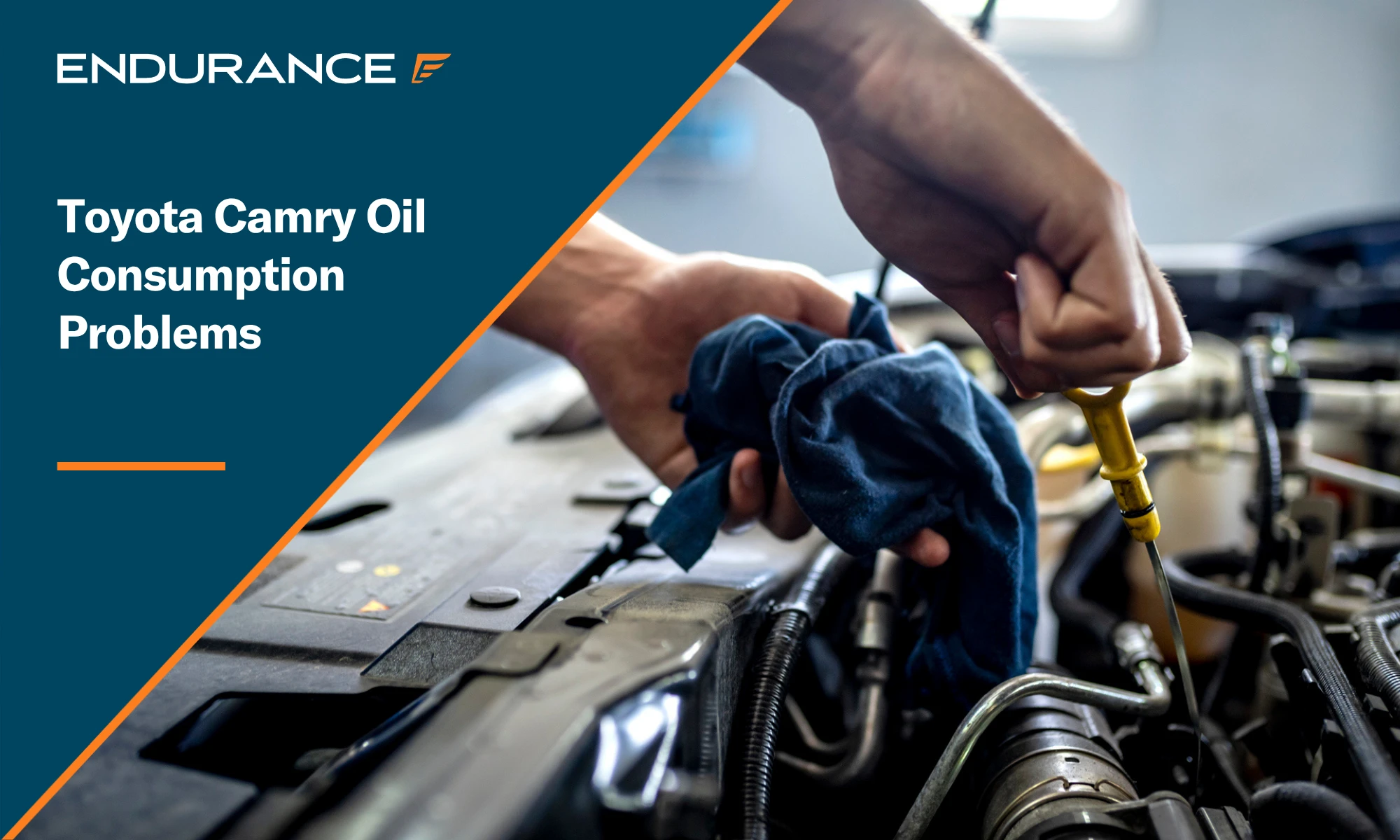
The Toyota Camry is one of the most consistently reliable vehicles on the market. For those looking for a quality vehicle that will last for many years, even when purchased used, the Camry is usually at the top of the list. There are, however, certain four-cylinder model years that have incredibly common issues with oil consumption. This can quickly result in serious engine damage and drastically reduce the lifespan of the vehicle.
Unfortunately, because of the nature of the defect, many Camry owners don’t realize there is oil burning until damage to the engine has already occurred. Knowing which model years are affected and what to watch out for if you have one of these Camrys will help you avoid expensive repairs and keep your car running smoothly for as long as possible.
The oil consumption issue is most closely tied to the 2.5-liter 2AR-FE four-cylinder engine, which was used in Camry models from 2010 to 2017. It was most common during the 2010 to 2014 model years, with Toyota’s warranty enhancement program specifically targeting this range. Owners of these vehicles reported that they were consuming a large amount of oil, even at fairly low mileage levels. If the oil level drops too low, insufficient lubrication can contribute to engine damage, particularly if the excessive consumption goes unnoticed or unaddressed.
Toyota acknowledged the issue in a Technical Service Bulletin (TSB) and linked the problem to the piston and piston-ring design. The low-tension oil control rings wore prematurely, allowing oil to seep past the pistons and into the combustion chamber, where it was burned during normal engine operation. Because the oil is consumed internally rather than leaking externally, many owners had no visible warning that their oil levels were dropping.
At the time, Toyota offered a warranty enhancement of 10 years or 150,000 miles for 2010–2014 models equipped with the 2AR-FE engine, covering piston ring replacement, valve seals, and the PCV valve. Toyota’s warranty enhancement provided coverage of up to 10 years or 150,000 miles for affected 2010–2014 models. Many of these vehicles are now outside that coverage window based on their age or mileage.
The biggest problem with dramatic oil consumption is that it often isn’t noticeable until the engine has already been damaged. Most drivers assume that their oil level is fine until they get an oil change or check the levels themselves using the dipstick. Because excessive oil consumption happens inside the engine, there is usually no sign, such as a puddle under the car or a burning smell. This means that you should keep an eye out for signs that are much more subtle.
One of the most common signs of excessive oil consumption is a faint blue tint to the vehicle’s exhaust. Blue exhaust smoke can occur when engine oil enters the combustion chamber and burns along with the air-fuel mixture. You may also notice a low-oil warning or find that the oil level on the dipstick has dropped significantly between scheduled oil changes. If the engine continues running with an insufficient oil level, inadequate lubrication can eventually lead to serious engine damage, even if you top off.
To find out if your vehicle is experiencing excessive oil consumption, there is a very important test that you need to take. The standardized oil consumption test involves draining and refilling the oil to a precise level, then driving between 1,000 and 1,200 miles. After that, technicians at the dealership can get an accurate read on how much oil has been lost.
There is an established threshold that Toyota has deemed acceptable for oil loss, but that does not mean that it is a safe level. Excessive oil consumption can allow the oil level to fall too low between changes, increasing the risk of inadequate lubrication and engine damage if the problem is not addressed. Doing so will give you the documentation you need to get the repairs done and keep your engine in great shape.
If the oil consumption issue is not taken care of, there are all kinds of problems that can show up later on. One of the most common is worn piston rings. Piston rings help seal the combustion chamber and control the amount of oil left on the cylinder walls. When the oil-control rings wear or fail, excess oil can enter the combustion chamber and burn during engine operation.
The piston rings themselves are quite inexpensive, but replacing them requires fairly significant work when dismantling the engine. You could be looking at a repair cost between $1,800 and $3,500, depending on the shop you go to.
The valve stem seals may also be the culprit if your Camry is losing excessive oil. Like the piston rings, the parts themselves are affordable, but the labor required can bring your repair bill to somewhere between $700 and $1,500.
If the issue is allowed to progress even more, you could also be looking at a complete engine replacement, which can cost $4,000 or more for a remanufactured unit, depending on the shop and your location. Doing everything you can to protect your Camry and your wallet will help you avoid the most expensive repairs.
While Toyota offered a longer extended warranty for Camry owners to try to rectify the oil consumption issue, it has since run out, leaving current owners in a lurch if their vehicle’s engine experiences difficulties. This means that a third-party extended warranty, which is more accurately called a vehicle service contract (VSC), is your best option if you own a Camry from the affected model years.
Endurance offers a range of available options for your Camry, with everything from basic powertrain coverage, which protects the engine, transmission, and drive axles, to the more comprehensive Supreme plan, which covers gaskets and seals. Coverage for engine components depends on contract terms and the cause of the breakdown, so Camry owners should review their coverage details before repairs are needed.
The engine problems that will arise due to low oil levels can be absolutely devastating for your vehicle and incredibly expensive to repair. Having a protection plan for your Camry is your best bet if you don’t want to get stuck with a repair bill adding up to thousands of dollars.
Endurance has a wide collection of plan options for all kinds of cars and drivers, whether you have an older high-mileage vehicle or an exotic luxury car. Endurance even covers vehicles that other providers won’t, such as Canadian Gray Market cars, vehicles with a salvage or rebuilt title, and cars used for commercial purposes like rideshare and delivery.
Comprehensive coverage is not the only benefit of becoming an Endurance customer. Each plan comes with a complete suite of standard benefits, including 24/7 roadside assistance, trip interruption protection, and rental car coverage. Plus, new contract holders can get our Elite Benefits set of perks free for one year. This includes tire repair or replacement, windshield coverage, key fob replacement, and more.
When you need the best coverage for your engine, get in touch with our team at (800) 253-8203 to get your FREE quote. You can also see your price right away by shopping online and getting an instant price preview.
For more helpful resources, be sure to check out the Endurance Warranty Blog. There, you will find provider comparisons, DIY tips, mechanical breakdown insurance information for California drivers, and much, much more.

We've received your vehicle information and will contact you shortly with your quote.
— OR —
Start shopping for a coverage plan now.


We're here to make sure you get the most comprehensive EV protection. That's why we've partnered with Xcelerate Auto to offer you transparent and dependable Tesla coverage.
Want us to contact you about XCare coverage for your Tesla?

Your protection is our top priority. Your quote is in progress and you will
receive a confirmation
email shortly.

Speak with a vehicle protection plan specialist and get $300 off any new contract instantly.
Spooky Savings: $300 off + FREE Elite Benefits for 1 year!
By clicking the button, you consent to Endurance using automated technology to call, email, and text you using the contact info above, including your wireless number, if provided, regarding auto protection or, in California, mechanical breakdown insurance. You also agree to the Endurance Privacy Policy and Terms and Conditions. Consent is not a condition of purchase, and you can withdraw consent at any time. Message and data rates may apply.
Speak with a vehicle protection plan specialist and get $300 off any new contract instantly.
Call 866-678-4172
or scan the code below

Simply fill out the information below and we will follow up fast with your free no-obligation quote.
By clicking the button, you consent to Endurance using automated technology to call, email, and text you using the contact info above, including your wireless number, if provided, regarding auto protection or, in California, mechanical breakdown insurance. You also agree to the Endurance Privacy Policy and Terms and Conditions. Consent is not a condition of purchase, and you can withdraw consent at any time. Message and data rates may apply.

To speak to a vehicle protection plan specialist and get $300 off any new contract instantly
Scan the code below



Michael O’Connor, a Bay Area writer and marketer, grew up restoring classic cars and learning to drive on the cross-country Americruise car show tour with his father. His interest in writing was inspired by car magazines and the rodding novels of Henry Gregor Felson. Michael is an alum of Sonoma State’s Creative Writing program and has been penning for the automotive industry since 2015.